







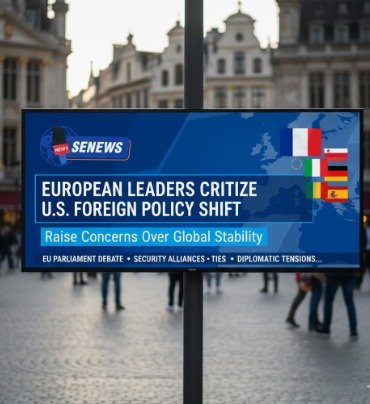
Paris/Berlin – January 9, 2026: European leaders have expressed deep concern over the recent direction of U.S. foreign policy, emphasizing that a withdrawal from international engagement could have far-reaching consequences for global security and diplomatic relations.
French President Emmanuel Macron and German President Frank-Walter Steinmeier, speaking in separate statements over the past week, highlighted what they described as a worrying trend of unilateralism by the United States. Both leaders stressed that international cooperation and multilateral institutions are essential for addressing challenges ranging from security threats to economic stability and climate change.
“This move away from working closely with our partners threatens the foundations of alliances that have ensured peace and prosperity for decades,” President Macron stated during a press briefing in Paris. “When key players retreat from shared responsibilities, the entire global system becomes more fragile.”
President Steinmeier echoed these sentiments in Berlin, noting that Europe has relied on strong transatlantic partnerships to tackle complex issues. “Global challenges cannot be solved in isolation,” he said. “The decision to step back from international frameworks weakens not only trust between nations but also the mechanisms that help prevent conflict.”
The criticism comes in response to a series of recent U.S. policy decisions, including the planned withdrawal from multiple international organizations and a series of statements downplaying the importance of international law. Analysts warn that such moves may strain diplomatic relations and prompt European nations to reevaluate their strategic dependencies on the United States.
Experts also note that Europe’s reaction reflects broader concerns about the erosion of multilateralism. “Alliances are built on shared commitments,” said Dr. Katarina Vogel, a foreign policy analyst at the European Council on Foreign Relations. “When one major partner signals that it may not honor these commitments, it creates uncertainty that can ripple across global markets, security arrangements, and climate initiatives.”
In response to these developments, European nations are reportedly exploring ways to strengthen intra-European cooperation and diversify diplomatic efforts, including greater engagement with Asia-Pacific and African partners. While the transatlantic relationship remains critical, leaders are signaling that Europe may need to adopt more independent strategies in the face of shifting U.S. priorities.
As international observers monitor these developments, the coming months are likely to be pivotal in determining how Europe and the United States navigate differences over global governance and shared responsibility.