





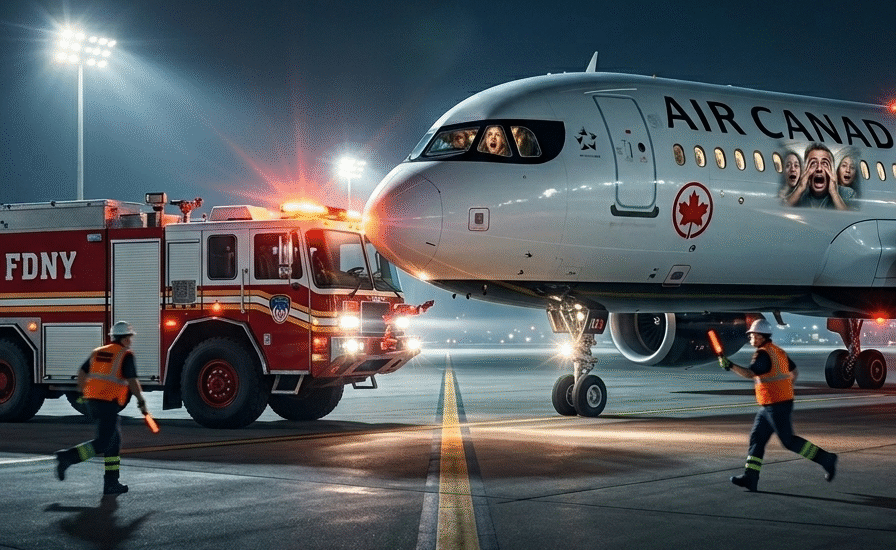
A serious airside incident at LaGuardia Airport in the early hours of Monday triggered widespread concern after a regional passenger aircraft operated by Air Canada collided with an airport fire truck on the runway. While a potential catastrophe was narrowly avoided, the collision resulted in injuries to emergency personnel and caused temporary disruption to flight operations at one of New York’s busiest aviation hubs.
According to preliminary information, the aircraft—an Air Canada Express regional jet arriving from Montreal—had successfully landed and was taxiing toward its designated gate when the incident occurred. During this routine ground movement, the aircraft came into sudden contact with a fire department vehicle that was present on or near the active runway.
Eyewitness accounts suggest that the aircraft was moving at a controlled speed when the crew became aware of the obstruction ahead. Despite attempts to halt or slow the aircraft, the proximity between the jet and the fire truck left little time to avoid impact. The resulting collision caused significant damage to the front section of the aircraft, particularly around the nose area, which reportedly lifted slightly due to the force of impact.
Emergency response teams stationed at the airport acted swiftly. Additional firefighting units, paramedics, and airport security personnel rushed to the scene within minutes. The injured individuals—primarily occupants of the fire truck—were provided immediate medical attention before being transported to nearby hospitals. Sources indicate that some of the injured personnel sustained serious injuries, though official confirmation on their condition is still awaited.
Passengers onboard the aircraft described moments of confusion and panic. Many reported hearing a loud jolt followed by abrupt movement inside the cabin. Although the situation was quickly brought under control, the psychological impact on those onboard was significant. Airport authorities ensured that passengers were safely deplaned and guided to secure areas for further assistance and evaluation.
At the time of the incident, the aircraft was believed to be carrying approximately 80 to 100 passengers. Fortunately, there have been no confirmed reports of life-threatening injuries among passengers, a factor being viewed as a major relief given the potentially severe consequences of such a collision.
In response to the incident, airport authorities temporarily suspended all flight operations at LaGuardia Airport. Departures were halted, and several incoming flights were diverted to nearby airports, including John F. Kennedy International Airport and Newark Liberty International Airport. The ground stop remained in effect until safety inspections and initial clearance procedures were completed.
Aviation regulators, including the Federal Aviation Administration (FAA), have initiated a formal investigation into the circumstances surrounding the collision. Key questions being examined include how both the aircraft and the emergency vehicle were present on the same operational surface at the same time, and whether there was any breakdown in communication between ground control and vehicle operators.
Early indications point toward a possible lapse in coordination or miscommunication. In highly regulated airport environments, strict protocols govern runway access, especially during aircraft movement. Any deviation from these procedures can create dangerous situations, as seen in this case. Investigators are expected to review air traffic control recordings, ground vehicle logs, and surveillance footage to reconstruct the sequence of events.
Weather conditions at the time of the incident are also being analyzed. While no official statement has confirmed adverse weather as a direct cause, some reports suggest that reduced visibility or surface conditions may have contributed to the difficulty in detecting the obstruction in time.
Aviation safety experts note that runway incursions—situations where unauthorized vehicles or aircraft enter an active runway—are among the most critical risks in airport operations. Modern systems are designed with multiple layers of redundancy, including radar monitoring, communication protocols, and visual signaling. However, human error, technical issues, or unexpected operational demands can still lead to rare but serious incidents.
In a statement released shortly after the event, Air Canada confirmed that it is cooperating fully with investigative authorities. The airline emphasized its commitment to passenger safety and assured that all necessary support is being extended to those affected by the incident. The company also stated that a detailed internal review is underway.
Airport authorities have similarly pledged full transparency and cooperation. Officials are expected to reassess ground movement procedures and emergency response coordination to prevent similar occurrences in the future.
The incident has once again highlighted the complexities of managing high-traffic airports where aircraft, ground vehicles, and personnel must operate in precise coordination. Even minor lapses can escalate rapidly into dangerous situations.
As investigations continue, further details are expected to emerge in the coming days. The findings will likely play a crucial role in shaping future safety protocols—not only at LaGuardia but across airports worldwide.
For now, while normal operations have resumed, the incident serves as a stark reminder of the importance of vigilance, communication, and strict adherence to safety procedures in modern aviation.