






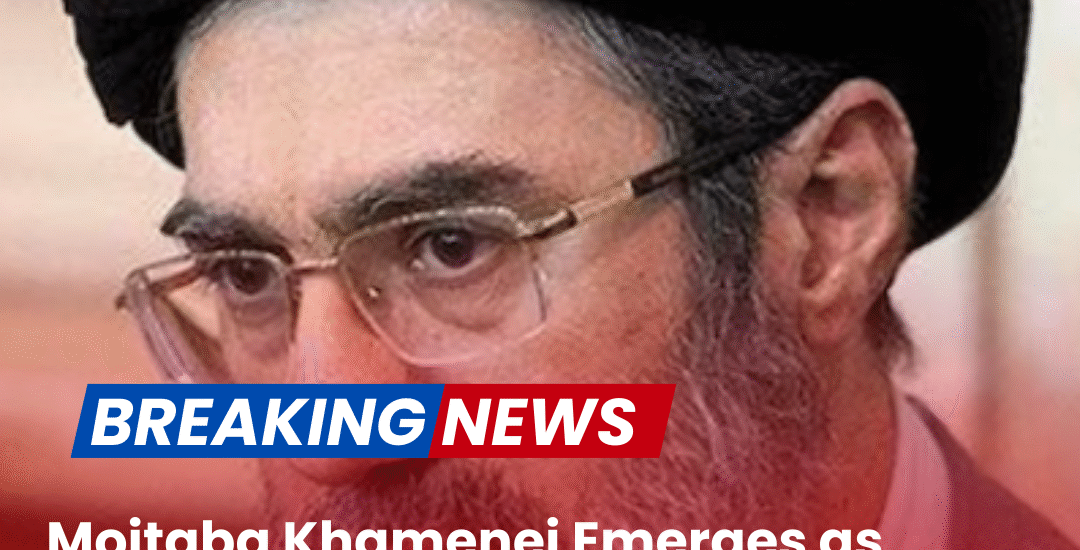
Iran has witnessed a major political development as a new figure has emerged to occupy the country’s most powerful position. Mojtaba Khamenei has reportedly been chosen as Iran’s new Supreme Leader, marking a significant transition in the leadership of the Islamic Republic.
The change comes after the death of Iran’s long-serving leader Ali Khamenei, who had held the position since 1989. During his decades in power, Ali Khamenei played a central role in shaping Iran’s domestic and foreign policies, making him one of the most influential figures in the Middle East. His passing created a leadership vacuum that required the country’s clerical establishment to select a successor.
In Iran’s political system, the Supreme Leader holds the highest authority in the state. Although the country elects a president and parliament, the Supreme Leader has ultimate control over key institutions such as the armed forces, the judiciary, state broadcasting, and major strategic decisions. This means the individual who occupies this role effectively shapes the direction of the country’s political, military, and ideological policies.
The responsibility for selecting the Supreme Leader lies with a powerful clerical body known as the Assembly of Experts. This council, made up of senior Islamic scholars, is tasked with appointing and supervising the Supreme Leader. Following internal consultations and voting procedures, the assembly reportedly approved Mojtaba Khamenei as the next leader of the country.
Mojtaba Khamenei, a Shia cleric, has long been considered an influential figure within Iran’s political and religious establishment. Despite maintaining a relatively low public profile and holding no prominent elected office, he is believed to have exercised considerable influence behind the scenes for many years.
Political analysts have frequently pointed to his close ties with Iran’s powerful military organization, the Islamic Revolutionary Guard Corps (IRGC). The IRGC plays a crucial role in Iran’s security structure and is deeply involved in regional politics, military operations, and strategic decision-making. His relationship with the organization is seen by some observers as a factor that strengthened his position within the country’s power structure.
However, Mojtaba Khamenei’s rise to the position of Supreme Leader has also sparked debate among political observers and international analysts. Some critics argue that his appointment could resemble a form of political succession within the same family, something that contrasts with the ideals that followed the 1979 Islamic revolution.
The Iranian Revolution had overthrown the monarchy in Iran and replaced it with a system based on religious leadership. For that reason, some observers believe that the emergence of the son of a former Supreme Leader in the same role may raise questions about the concentration of power within a particular circle of influence.
The leadership change is also expected to have broader implications beyond Iran’s borders. Iran is a key regional power in the Middle East and plays an active role in many geopolitical issues, including regional conflicts, diplomatic relations with neighboring countries, and tensions with Western powers.
As a result, international observers are closely watching how Mojtaba Khamenei will approach critical issues such as Iran’s foreign policy, regional alliances, and its controversial nuclear program. His leadership style and policy decisions could significantly influence the balance of power in the region.
At home, the new leader is likely to face several challenges as well. Iran has been dealing with economic pressures, international sanctions, and internal political tensions for years. Managing these issues while maintaining stability within the country’s political system will be one of the major tests of his leadership.
For now, Mojtaba Khamenei’s appointment marks the beginning of a new chapter in Iran’s political history. While the full impact of the leadership transition remains uncertain, analysts agree that the development could shape the country’s future direction and influence geopolitical dynamics across the Middle East in the years to come.