







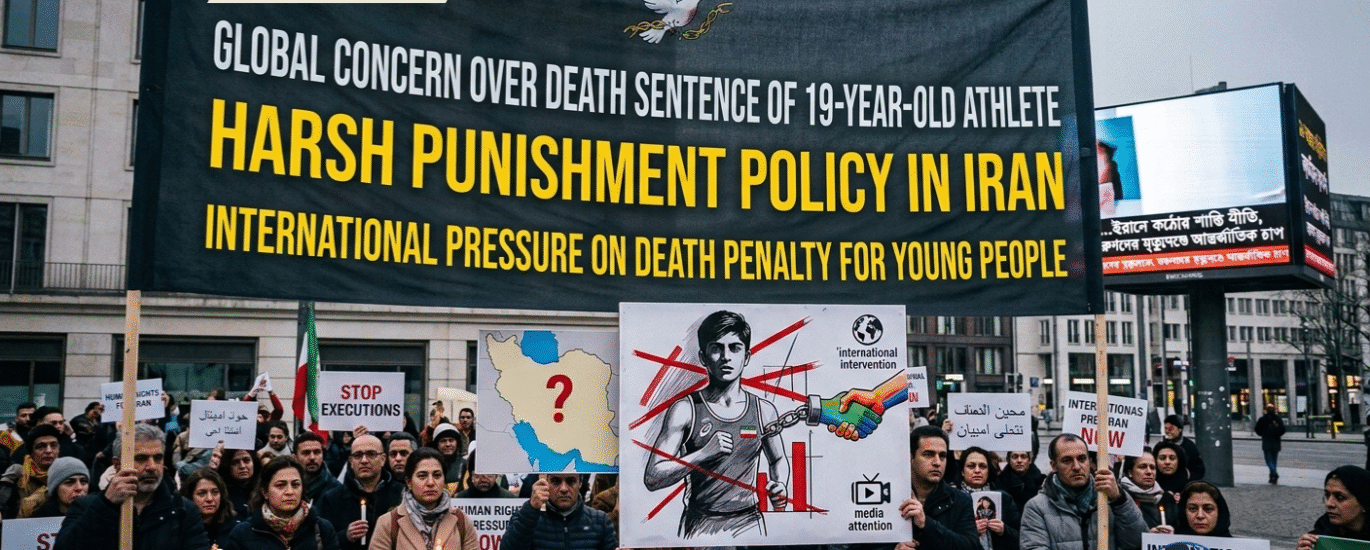
The execution of a 19-year-old wrestler in Iran has triggered widespread international concern, with human rights groups warning that it may signal a broader wave of harsh punishments against young protestors. The case has not only drawn attention due to the age of the accused but also because of growing allegations regarding the lack of transparency and fairness in the country’s judicial process.
The individual at the center of the controversy, Saleh Mohammadi, was reportedly executed by hanging in the religious city of Qom. According to multiple reports, he was executed alongside two other young men on the same day. Authorities had convicted them under the charge of “moharebeh,” a term in Iranian law that translates to “waging war against God,” which carries the death penalty.
Background of the Protests
The events leading to this execution are closely tied to a wave of anti-government protests that spread across Iran in early 2026. These demonstrations were fueled by economic hardship, political dissatisfaction, and demands for greater civil freedoms. Young people formed a significant portion of the protestors, many of whom took to the streets in defiance of strict government controls.
Authorities alleged that Saleh Mohammadi was involved in violent activities during these protests. However, rights groups and activists argue that such accusations are often broadly applied and lack concrete evidence. In many cases, individuals detained during protests are accused of serious crimes without transparent investigation procedures.
Concerns Over Judicial Process
The case has intensified scrutiny over Iran’s legal system, particularly in politically sensitive cases. Critics claim that defendants like Mohammadi are often denied adequate legal representation and are subjected to expedited trials that leave little room for a proper defense.
International human rights organization Amnesty International has expressed serious concern over the conduct of such trials. According to the organization, there are credible allegations that confessions in some cases have been extracted under coercion or torture. These claims, if proven, would represent significant violations of international human rights standards.
Legal experts also point out that the charge of “moharebeh” is sometimes used in a broad and ambiguous manner, allowing authorities to apply it to a wide range of actions, including participation in protests. This has raised fears that the legal framework is being used as a tool to suppress dissent rather than to ensure justice.
International Reaction
The execution has prompted reactions from governments and international bodies across the world. Several countries have called on Iran to reconsider its use of capital punishment, especially in cases linked to political unrest.
Officials from the United Nations have voiced concern over the increasing number of death sentences related to protest activities. A spokesperson noted that executing individuals for alleged involvement in demonstrations undermines fundamental human rights principles, including the right to life and the right to a fair trial.
Diplomatic pressure is expected to increase in the coming weeks, as more details about similar cases emerge. Analysts believe that Iran may face growing isolation if such incidents continue to draw condemnation from the global community.
Impact on the Sporting Community
The execution of a young athlete has also resonated deeply within the international sporting community. As a wrestler, Saleh Mohammadi was considered a promising talent, and his death has sparked outrage among athletes and sports organizations.
Many have expressed concern that athletes, who are often seen as symbols of unity and national pride, are not being spared from political crackdowns. The incident has reignited debates about the role of sports in politically restrictive environments and the vulnerability of young athletes in such contexts.
Fears of Further Executions
Perhaps the most alarming aspect of this case is the possibility that it may not be an isolated incident. Human rights groups have warned that several other individuals detained during recent protests are facing similar charges and could also be sentenced to death.
Reports suggest that authorities are continuing to pursue harsh penalties against those accused of participating in anti-government demonstrations. If these trends persist, there is a growing fear that more executions could follow in the near future.
Experts caution that such actions may further escalate tensions within the country, potentially leading to renewed unrest. At the same time, they argue that increased international scrutiny could play a role in influencing the government’s approach.
Conclusion
The execution of Saleh Mohammadi highlights the complex and increasingly tense situation in Iran. While the government maintains that it is enforcing the law, critics argue that the justice system is being used to silence dissent and instill fear.
As the international community continues to monitor developments, the case raises critical questions about justice, human rights, and the balance between state authority and individual freedoms. Whether this incident will lead to meaningful change or further escalation remains uncertain, but its impact is already being felt far beyond Iran’s borders.