




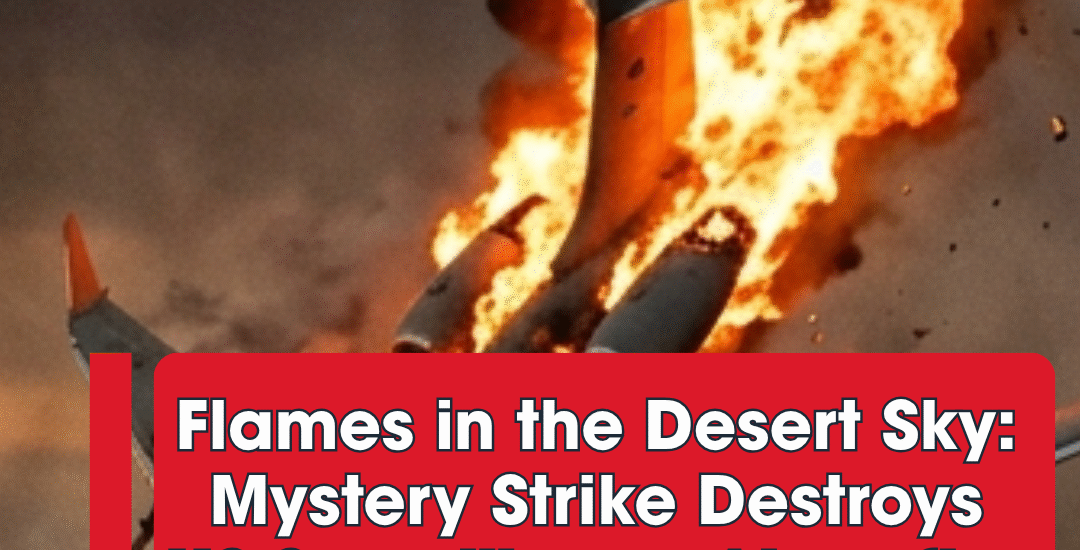
A series of striking images emerging from the Middle East has ignited intense global concern, revealing the destruction of a high-value United States military aircraft under circumstances that remain deeply contested. The aircraft in question, an E-3 Sentry Airborne Warning and Control System (AWACS), is widely regarded as one of the most critical assets in modern aerial warfare. Its apparent destruction has raised urgent questions about regional security, military preparedness, and the potential escalation of tensions between major powers.
The incident is reported to have occurred at a key airbase in Saudi Arabia, a location that has long served as a strategic hub for US military operations in the region. While initial reports suggest that the aircraft was targeted in a coordinated strike, possibly involving missiles or unmanned aerial systems, official confirmation remains limited. Nevertheless, the visual evidence—burnt fuselage sections, collapsed radar structures, and scorched runway surroundings—points to a significant and deliberate impact.
What makes this development particularly alarming is not just the loss of equipment, but the nature of the asset itself. The E-3 Sentry is not a conventional aircraft. It serves as an airborne command and control center, equipped with a powerful rotating radar dome capable of detecting aircraft, missiles, and other aerial threats over vast distances. In many ways, it acts as the “eye in the sky,” coordinating air operations, guiding fighter jets, and maintaining situational awareness across complex battle environments.
Military analysts have long emphasized the strategic importance of such platforms. Unlike fighter jets or bombers, which operate in direct combat roles, AWACS aircraft enable coordination and communication that underpin entire military campaigns. Losing even one such system can temporarily weaken surveillance coverage and reduce operational efficiency, especially in volatile regions like the Middle East.
The timing of the incident has only added to the unease. In recent weeks, tensions between Iran and the United States have been steadily escalating, marked by a series of indirect confrontations, proxy engagements, and heightened military posturing. Against this backdrop, the destruction of a US surveillance aircraft—whether confirmed as an attack or not—carries significant geopolitical implications.
Although some reports have attributed responsibility to Iran, suggesting the use of precision-guided missiles or drone swarms, there has been no official acknowledgment from Tehran. Similarly, US authorities have yet to release a detailed statement outlining the cause of the damage or identifying those responsible. This ambiguity has created a vacuum filled by speculation, strategic messaging, and competing narratives.
Defense experts caution against drawing immediate conclusions, but they also acknowledge that the sophistication of the damage indicates a high level of capability. If the aircraft was indeed targeted intentionally, it would suggest that the attackers possessed both the intelligence to identify a high-value target and the technology to strike it effectively within a heavily monitored military zone.
Another critical dimension of the incident lies in the vulnerability it exposes. Airbases, once considered relatively secure zones, are increasingly at risk from modern threats such as long-range missiles and autonomous drones. The apparent success of such an attack—if confirmed—could signal a shift in the balance of power, where even the most advanced military infrastructure is no longer immune.
In strategic terms, the loss of an E-3 Sentry also has operational consequences. The United States maintains a limited fleet of these aircraft, each representing a substantial investment in both cost and capability. Replacing or repairing such a system is neither quick nor simple. In the interim, surveillance coverage may need to be supplemented by alternative platforms, including satellites, fighter-based radar systems, or allied resources.
The broader international community is watching closely. Any escalation between the United States and Iran has the potential to disrupt global energy markets, destabilize neighboring countries, and trigger wider military engagement. Diplomatic channels are reportedly active, with several nations urging restraint and calling for an independent investigation into the incident.
Meanwhile, the images themselves continue to circulate, serving as a stark reminder of the fragility of modern security structures. A once-formidable aircraft, designed to monitor threats from miles away, now lies grounded and destroyed—its fate raising more questions than answers.
Was this a calculated strike, a defensive maneuver, or a tragic failure of security protocols? Could this incident mark the beginning of a new phase in regional conflict, or will it remain an isolated episode in an already tense environment?
For now, the answers remain uncertain. What is clear, however, is that the destruction of such a critical asset has altered the strategic conversation. As investigations continue and governments weigh their responses, the world finds itself once again on edge—watching closely as events unfold in a region where even a single incident can have far-reaching consequences.
The coming days are likely to prove निर्णायक, not only in determining the facts behind this incident but also in shaping the trajectory of international relations in one of the world’s most sensitive geopolitical arenas.