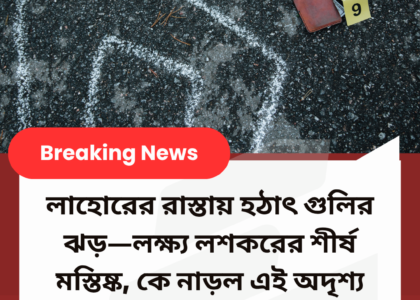





In a shocking turn of events that has raised serious questions about security and internal dynamics within extremist networks, Lahore witnessed a sudden burst of gunfire in broad daylight. The target was not an ordinary individual, but a controversial and internationally scrutinized figure—Aamir Hamza, co-founder of Lashkar-e-Taiba. Critically injured in the attack, he is currently battling for his life in a hospital.
According to initial reports, the incident took place outside a media office in Lahore. Unknown assailants opened fire, specifically targeting Hamza. The precision and timing of the attack have led analysts to believe that this was not a random act of violence, but a carefully planned operation with deeper implications.
Who is Aamir Hamza and why does he matter?
Aamir Hamza has long been a known name in global security circles. As one of the founding members of Lashkar-e-Taiba, he played a key role in shaping the organization’s structure and ideology. He is also believed to have maintained close ties with Hafiz Saeed, the group’s chief.
However, Hamza’s influence extended beyond operational roles. He was also a prominent ideologue, known for his fiery speeches and writings. He contributed significantly to the organization’s propaganda machinery, serving as an editor for its publications and authoring several books that promoted extremist ideology.
More than a militant—an ideological force
Security experts often describe Hamza as a dual-force figure—someone who operated both on the ground and in the realm of ideas. His ability to recruit, influence, and indoctrinate new members made him a valuable asset to the organization.
Targeting such a figure is not just an attack on an individual but a potential blow to the ideological backbone of the group. This adds another layer of complexity to the incident.
Under international scrutiny
Hamza has been on international watchlists for years. The U.S. Treasury Department has designated him under sanctions, citing his involvement in terror financing, recruitment, and coordination between extremist factions.
He has also been linked—through various intelligence reports—to multiple attacks, including those targeting India. While official confirmations vary, his name has repeatedly surfaced in discussions surrounding cross-border terrorism.
Distancing from Lashkar—or a strategic shift?
Around 2018, following financial sanctions on Lashkar-affiliated organizations, Hamza reportedly began distancing himself from the core group. He later formed a separate outfit, which has also drawn attention for alleged involvement in militant activities, particularly in Jammu and Kashmir.
However, experts suggest that such “distancing” may not always be genuine. Often, these moves are strategic—designed to evade international pressure while continuing operations under a different structure.
Who could be behind the attack?
The biggest question now is—who targeted Aamir Hamza?
Several possibilities are being explored:
Internal rifts within extremist groups
Rival factions seeking dominance
A covert international operation
Personal or financial disputes
Given the high-profile nature of the target, analysts believe the attack was likely orchestrated by a well-organized network with access to precise intelligence.
Pakistan’s security under scrutiny
This incident has once again put Pakistan’s internal security apparatus under the spotlight. Lahore, being a major urban center, is expected to have strong surveillance and protection systems in place. Yet, such an attack in a public area raises serious concerns.
It suggests that despite efforts, certain networks continue to operate with significant freedom, posing risks not only domestically but also internationally.
Regional implications—India watching closely
Given Hamza’s alleged links to attacks in India, the development is being closely monitored across the border. While there has been no official response yet, intelligence agencies are likely assessing whether this incident signals a shift within militant structures.
Changes in leadership or internal conflicts within such groups often lead to shifts in strategy, which can have broader regional consequences.
Analysis: A multi-layered event
This is not just an isolated shooting—it is a complex event with multiple layers:
Possible internal power struggles
Impact of international pressure
Changing dynamics within extremist networks
Broader implications for regional security
Each of these aspects makes the incident far more significant than it may initially appear.
Conclusion
The attack on Aamir Hamza is a stark reminder that in the world of militancy, power equations are constantly shifting. Even those who once held influence are not immune to becoming targets.
The key question remains—was this a standalone act, or the beginning of a larger realignment within extremist networks?
As investigations continue, one thing is certain: the ripple effects of this incident will extend far beyond Lahore, potentially influencing security and political narratives across the region.